
Day 1
Saturday, 14 November 2026
- Welcome & check-in
- Opening and challenge briefing
- Team formation
- Hacking begins
- Checkpoint & meal break
48 hours to turn NASA's open data into working solutions alongside thousands of teams around the world, over a single weekend.
Countdown to the opening : Saturday, 14 November 2026 at 09:00
In 2025, 551 local events took place over the same weekend, across 167 countries. Here is the recap published by NASA.
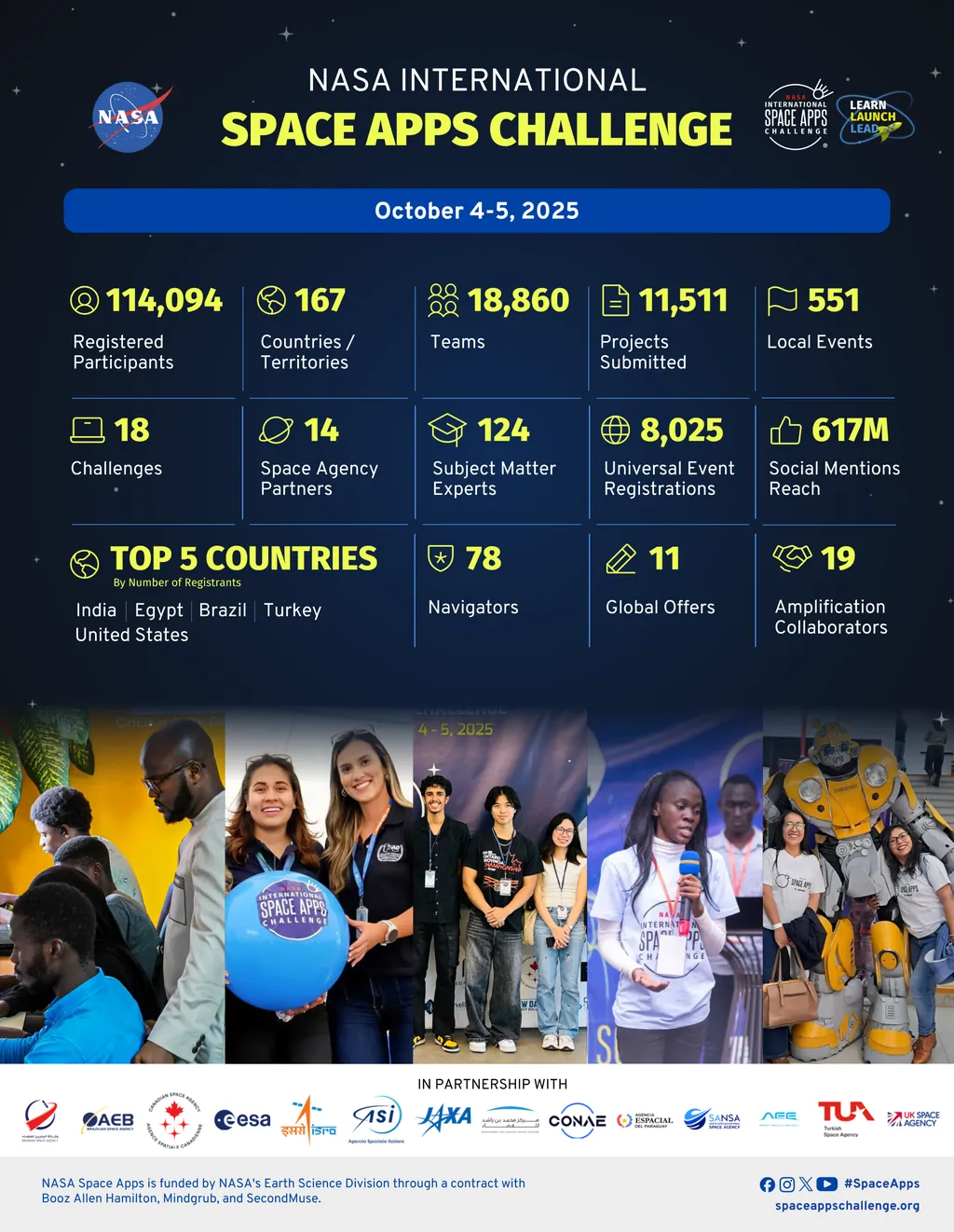
The best local projects go to the global judging round, which names ten winners each year.
Every generation inherits a frontier and decides what to do with it. Ours is made of open data, satellites and unanswered questions. In 2026, that frontier runs through Abidjan.
New worlds, new orbits, new data. The frontier begins where the map ends.
Open data from NASA and its partner agencies becomes answers to real problems.
In 48 hours, teams of up to 6 people turn an idea into a prototype.
The NASA Space Apps Challenge is the world's largest space hackathon: a weekend where coders, scientists, designers, storytellers, makers and curious minds of every background team up to tackle real challenges built on open data from NASA and its partner agencies.
Space Apps Abidjan is the Ivorian local edition, run by Alpha Space Robotics. Two days to form a team, pick a challenge, prototype a solution (software, hardware, visual or narrative) and present it to a jury, alongside Abidjan's space and tech community.
No space experience is required: the event brings together curious students and beginners as readily as seasoned engineers, designers and data scientists.
The programme is not run by NASA alone. Seventeen space agencies contribute to it, including Senegal's space studies agency and Nigeria's NASRDA. West Africa is represented.
GGPEN (Angola) · CONAE (Argentine) · Bahrain Space Agency · AEB (Bresil) · Agence spatiale canadienne · ESA (Europe) · ISRO (Inde) · ASI (Italie) · JAXA (Japon) · KASA (Coree du Sud) · NASRDA (Nigeria) · Agence spatiale du Paraguay · ASES (Senegal) · AEE (Espagne) · TUA (Turquie) · MBRSC (Emirats arabes unis) · UK Space Agency
NASA publishes the official 2026 challenge catalogue closer to the event. In the meantime, here are the broad challenge families offered in previous editions.
The exact 2026 challenges will be announced on spaceappschallenge.org and relayed here as soon as they are published.
This is the path NASA defines for every local event. Everything happens on spaceappschallenge.org, and most choices stay changeable until 15 November.
On spaceappschallenge.org. Everything else follows from this.
Registration stays open until 15 November, the day the event closes.
From more than 450 local events. You can change your choice until 15 November.
From 17 September, up to 6 people. Coming alone is fine: time is set aside at the start to form teams, both on site and online.
During the weekend of 14–15 November, through the official platform.
Before 30 November. It is what makes your participation count.
Indicative schedule: exact times will be confirmed together with the host venue.
The Abidjan edition is being built right now. The first organisations to come on board will have their logo here, and visibility with every participant.
Registration for the Space Apps Challenge takes place on NASA's global website. For any question about the Abidjan edition, write directly to the local committee.
Register on spaceappschallenge.org Email the local committeeNo. Teams are multidisciplinary: development, design, data, science communication and project management all have a place. Motivated beginners are welcome.
Yes, taking part in Space Apps Abidjan is free, in line with the rules of the global programme.
No, you can come on your own: time is set aside at the start to form teams, both on site and online.
Yes. The Abidjan edition welcomes participants both on site and online. You choose when you register, and the choice stays changeable until 15 November. Nothing stops you registering remotely and then coming in person.
Up to 6. A smaller team works perfectly well: what matters is the mix of skills, not the headcount.
This information will be published on this page and on Alpha Space Robotics's channels as soon as it is confirmed.
The event is held in French. NASA's datasets and part of its documentation are in English.